The challenge of this profession is learning how to live comfortably inside the tensions that come with proximity to leadership, explains Gina Theofilidou
One of the biggest misconceptions I carried early in my career was believing that experience would eventually remove uncertainty from my role. If I learned enough, observed enough, and worked hard enough, surely the difficult questions would eventually disappear! I would know exactly when to step forward, when to speak up, when to act independently, and when to seek approval. Instead, I discovered the opposite.
The longer I worked alongside leaders, the more I realised that the questions were not getting easier. In fact, many of them never seemed to go away. Much later, I came across the concept of polarity thinking, developed by Barry Johnson, and suddenly many of those experiences made sense. A problem has a solution, but a polarity holds two truths that both matter, and that never fully resolve. “What time is the flight?” is a problem. “How much initiative can I take?” is a polarity. There is no permanent right answer to the second question. The answer shifts depending on the leader, the context, and the moment.
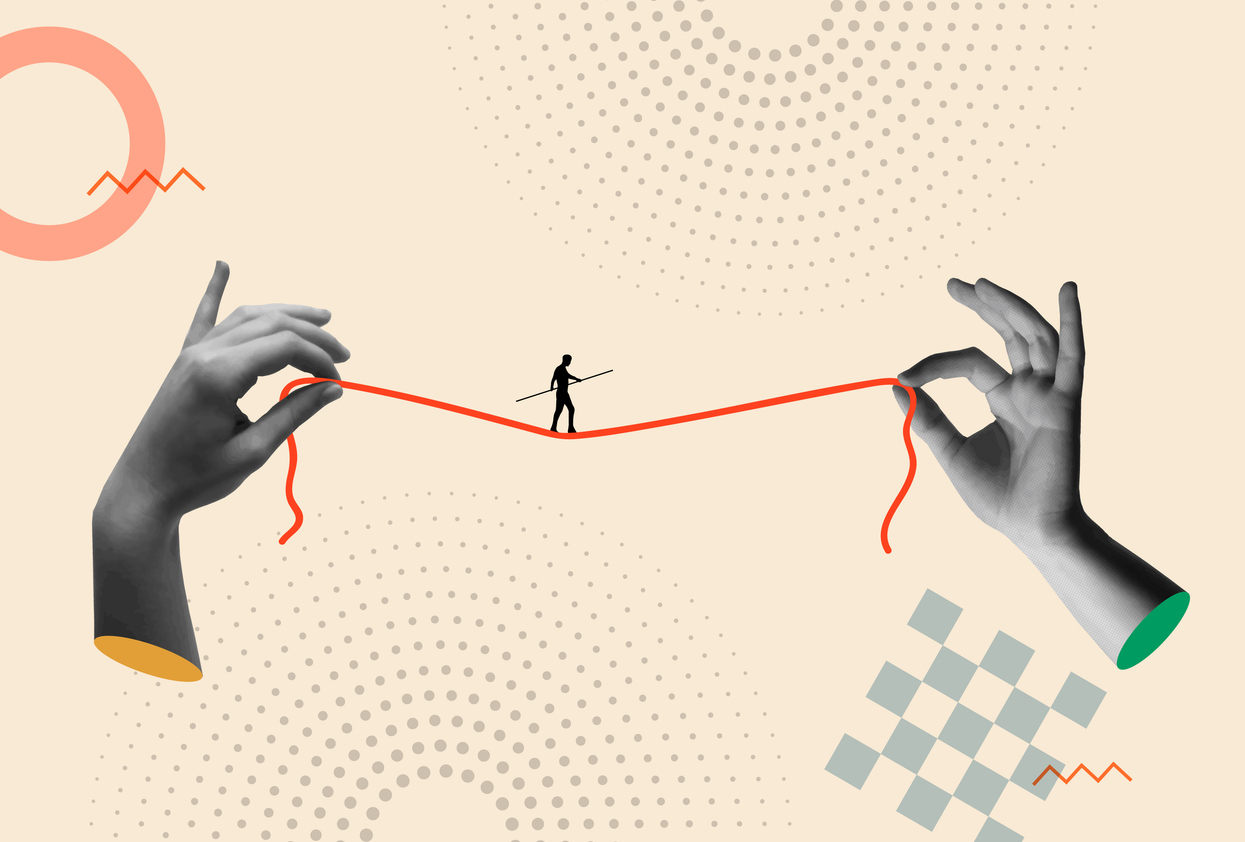
The strongest partnerships are not the ones that solve the tension; they are the ones that learn to balance it well.
The Tensions Inside the Partnership
Sit inside any close working relationship and you can feel these polarities and tensions at work. There is both visibility and discretion: the pull to be seen and credited, set against working in the background. Step too far into the light and you crowd your executive. Stay too far in the shadow and you become invisible, and invisible people are the first to be cut.
There is strategic partner and service mindset: the ambition to shape decisions, set against the discipline of getting the basics done well. Chase the strategy and drop the logistics, and you lose the trust that earned you the seat in the first place.
There is loyalty to your executive and responsibility to the organization: the instinct to protect one person, weighed against your duty to the wider business. Most of the time these point the same way; when they don’t – that is when the role gets hard.
Underneath all of them sits the one I have wrestled with most: autonomy and dependence. How much should you act on your own judgement, and how much should you wait, check, and ask? Too little autonomy and you are a bottleneck; too much, and you act on a picture you do not fully have. Both sides matter; it is a question of moving between them as the moment asks.
Why These Tensions Create Anxiety for Assistants
This is where anxiety lives. Our profession prizes certainty, efficiency, and control; the polarities and tensions offer none of those. They are uncertain by their very nature.
We carry two opposite fears at once. The fear of overstepping, of being told we went too far, and the fear of disappearing, of becoming invisible, undervalued, and easy to overlook. We hear mixed messages from our organisations too. Be strategic and visible, they say in one breath. Stay behind the scenes, they say in the next. And always, underneath, there is the pressure to keep proving our value, as if it might disappear the moment we stop. When the rules will not stand still, even capable people begin to doubt themselves.
What makes these tensions particularly challenging is that they not only affect what we do, they affect how we see ourselves.
Many Assistants are anxious not because they do not know how to perform a task, but because they are trying to answer a deeper question: Who am I expected to be here? Am I the trusted gatekeeper? The strategic advisor? The invisible operator? The loyal confidant? Most days, the answer is all of them.
The complexity of the role lies in the fact that our professional identity is rarely defined by a single expectation. We move constantly between different responsibilities, relationships, and levels of influence. The tensions we feel are a sign that we are operating in a role that requires continuous judgement rather than fixed answers.
A Lesson I Learned the Hard Way
Early in my career, I supported a managing director who travelled constantly. I prided myself on initiative. I anticipated. I pre-empted. I removed the friction before he ever felt it.
Over time, I began making more and more calls on his behalf, to save him time. I declined meeting requests I judged to be low priority. I drafted and sent replies in his voice. One of the meetings I waved away was a quiet request from a board member. I read it as routine, but it was not. It concerned a decision he badly wanted to be part of, and he learned he had missed it from someone else.
He was not angry. He simply began to include me less. That was almost worse. The copied emails thinned out. The early heads-up conversations stopped. I remember the first meeting I walked into without knowing what it was about, and the small, cold realization that I was now on the outside.
I had taken so much autonomy that I had broken the very thing autonomy depends on: his trust that I was acting on the full picture. The more independent I tried to be, the less he relied on me. The less he relied on me, the less I could do.
For a while I treated this as a problem to fix, and I overcorrected. I checked everything. I escalated everything. I waited for permission on work I could easily have owned. That was just as damaging, only in the opposite direction. Now he had a bottleneck where he used to have a partner.
What changed first was my thinking. I stopped searching for the correct, fixed amount of independence, and I realised no such number exists. Autonomy and dependence were never a problem with a solution. They were a dial we would adjust together, for as long as we worked side by side. In a crisis, he wanted me to act first and explain later. In calmer, more political moments, he wanted to be consulted. The line moved. That was not a sign I was getting it wrong; that was the nature of the thing.
Practical Ways to Manage Polarity
Read the situation, not the rule
Many Assistants search for the correct answer: Should I be more visible? More autonomous? More strategic? In reality, leadership dynamics are highly contextual. The skill is learning to read the moment.
Notice when the balance is shifting
Most tensions become problematic long before they become obvious. Frustration, repeated misunderstandings, second-guessing, or a sudden increase in approvals can all be signals that the partnership needs recalibrating. Most problems start when we stay too long on one side without noticing it.
Replace assumptions with conversations
Every executive has a different definition of autonomy, visibility, loyalty, and partnership. The strongest relationships do not rely on guesswork. They rely on ongoing conversations about expectations, boundaries, and decision-making.
Expect the line to move
The balance that works today may not work tomorrow. During a crisis, a leader may want you to act first and explain later. During a politically sensitive period, they may want greater involvement. The line moves, and effective partnerships move with it.
Develop judgement, not rules
Rules tell us what worked before; judgement helps us decide what is needed now. The longer I work alongside leaders, the more I believe that professional maturity comes not from finding certainty, but from becoming comfortable navigating complexity.
Above all, remember that the goal is awareness. The strongest executive–Assistant partnerships are built through continual observation, communication, and recalibration.
A Final Reflection
The longer I do this work, the more I believe that judgement matters more than certainty. The strongest partnerships are held by people who are willing to keep talking about where the balance needs to be. Looking back, I no longer see tensions as evidence that something is wrong; I see them as part of the role itself. Perhaps that is the real challenge: learning how to navigate tensions with judgement, trust, and conversation.