
Julia Schmidt explains how intentional learning can increase your long-term professional value and contribute to the success of your organization
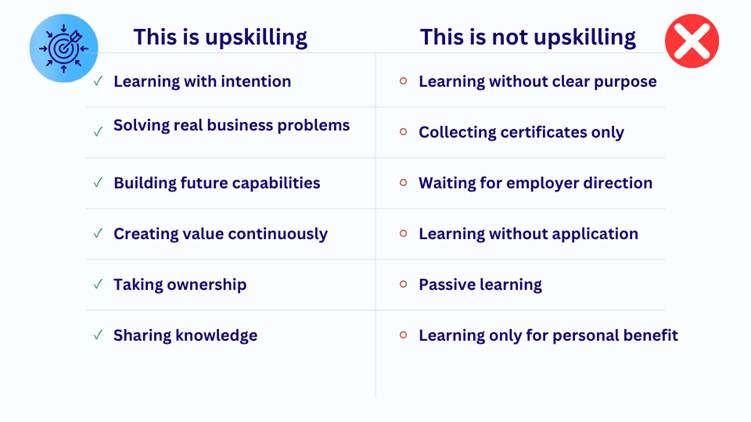
Upskilling is learning that expands your current skill set. More importantly, it is intentional learning directed toward building capabilities that increase your long-term professional value. It is the deliberate process of continuously developing the capabilities that allow you to remain relevant, adaptable, and valuable in an increasingly changing professional environment. For me, upskilling is also about continuous value creation.
Upskilling is often perceived as either an individual responsibility or an organizational initiative, but in reality, it is both. Organizations need to employ skilled, adaptable professionals in order to remain competitive. At the same time, professionals need to continuously evolve in many ways to stay relevant. The intersection of these two realities is where real value is created.
This is why upskilling is a strategic journey, one where personal growth and organizational priorities are closely connected. Upskilling works best when it is seen as a value exchange: the organization invests in your development, and you invest in contributing to the organization’s success. When both sides understand this dynamic, learning becomes a shared responsibility and a source of competitive advantage.
Agency: The Turning Point in the Learning Journey
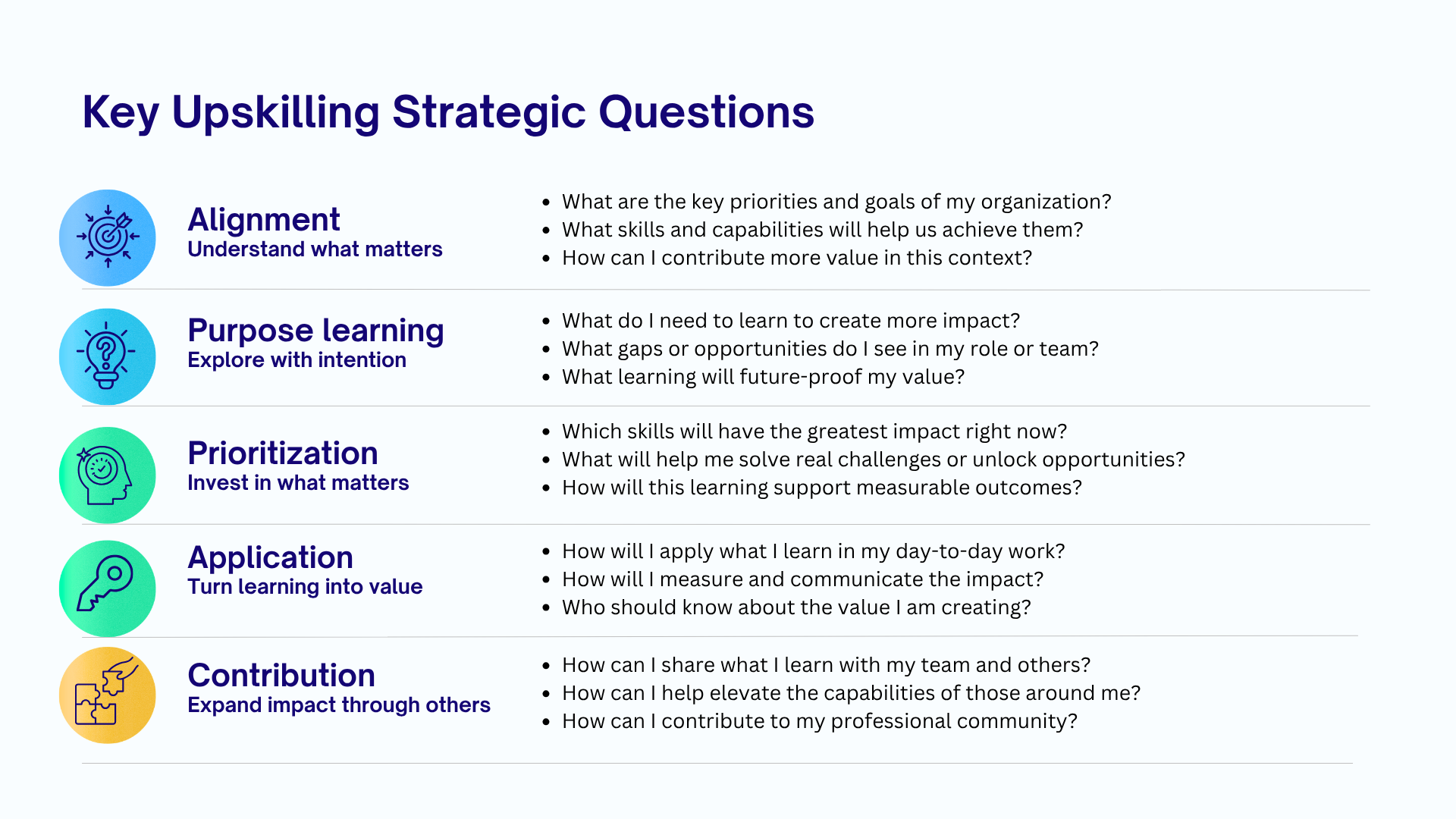
At its core, learning solves problems. Before investing time in developing a new skill, I believe we should first ask ourselves a fundamental question: “What problem am I trying to solve?” The answer might be “I want to be trusted as a more effective operational leader,” or “I want to move into more impactful work and create greater business contribution.” It can also be “I want to become a trusted AI enabler within my team, helping others work more effectively while supporting innovation and new ways of creating value.”
Once we begin connecting learning to the problems we are trying to solve, professional development stops being an activity and becomes a deliberate investment in our future. In that sense, upskilling is not simply about keeping pace with change. It is about intentionally evolving in ways that allow us to remain valuable today while preparing ourselves for the professional challenges of tomorrow.
Too often, learning is expected to be provided by the organization, by managers, or through formal development programs, when in fact the professionals who grow the most are those who intentionally take responsibility for their own learning and take agency. They seek opportunities instead of waiting for them, initiate conversations with managers and colleagues about their development, and connect their learning to real business needs. Agency is what transforms professional growth from a possibility into progress.
I experienced this personally several years ago when I made the decision to become the national chair of a global association of management support professionals. At that stage of my career, I understood that if I wanted to continue growing professionally, I needed to deliberately place myself in environments that would challenge me beyond the boundaries of my formal corporate role. It was a conscious decision to strengthen my leadership capabilities, share knowledge with other professionals, and invest intentionally in my own long-term development.
It also became an opportunity to put into practice what I had learned through my education in business administration and, equally important, to maintain and continuously strengthen the skills that would help me stay ahead of the curve. I understood early that formal education alone would never provide permanent relevance in an increasingly changing workplace. What would ensure long-term professional value was my ability to approach development strategically and continuously evolve alongside the changing demands of the profession.
This was an important realization for me: upskilling can be transformative. It fundamentally changed how I grow, adapt, and continuously increase the value I create over time.
Interestingly, at the same time, I was participating in a company leadership program together with department managers. Looking back, I see that both experiences became part of the same strategic learning plan: deliberately developing myself both inside and outside the organization, while building the capabilities required to evolve into a more strategic partner to my CEO.
The Five Pillars of a Strategic Learning Journey
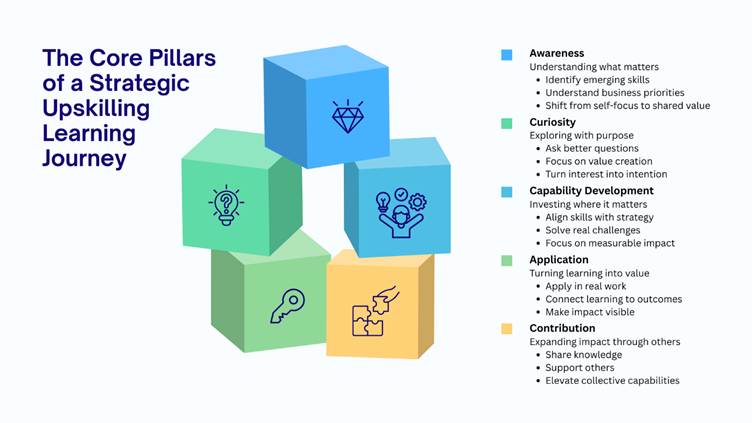
From my experience, a meaningful learning journey is built on five core pillars. Each one reinforces the other, and what makes the difference is how intentionally they are approached. These pillars do not follow a fixed order. They evolve continuously and strengthen your ability to create value over time.
1. Awareness: Understanding what the organization needs
Growth starts with understanding context – what skills are emerging and what skills your organization needs to succeed. This shift from self-focus to shared value is critical.
2. Curiosity: Exploring with purpose
Curiosity becomes more powerful when it is directed. Instead of asking “What would I like to learn?”, the question becomes “What must I learn to create more value for myself and my organization?” This is where learning becomes strategic.
3. Capability development: Investing where it matters
Not all skills have the same impact. It is important to prioritize development efforts that directly support business objectives and key performance indicators. The most valuable professionals focus on skills aligned with organizational priorities, capabilities that solve real problems, and areas where they can make a measurable difference.
4. Application: Demonstrating value
Learning creates impact only when it is applied – but more importantly, it needs to be visible. Employees who clearly communicate how their learning benefits the organization are more likely to gain support and recognition. This means connecting your learning to outcomes, sharing your insights with others, and demonstrating how your new skills support the team.
5. Contribution: Expanding your impact through others
You can extend the impact of your learning beyond your immediate role, into your team, your organization, and the professional communities you are part of. You move from individual growth to collective growth, sharing what you have learned within and beyond your workplace. You support your team and you elevate the capabilities of others, translating your learning into leadership.
I experienced this directly when I decided to create an internal network of administrative professionals in one of the organizations where I worked. My intention was to create a platform where learning could become continuous rather than occasional. My colleagues and I actively shared knowledge, exchanged practical experiences, discussed emerging trends affecting our profession, and continuously asked ourselves an important question: “What must we learn in order to better support the evolving needs of the organization?” It became a collective effort to identify where we needed to grow together and how our development could better support the business. This experience reinforced for me the power of learning not only for individual growth, but for elevating collective capabilities and creating shared value within our professional group.
Extending the Journey: Learning Through Association Leadership
There is another dimension of professional growth that I have experienced personally and that I believe deserves more attention. My leadership journey within IMA (International Management Assistants) has become one of the most important parts of my own professional development. Over the years, I have progressed through international leadership roles and today serve as Executive Chair of IMA. Each role has become an opportunity to deliberately expand new capabilities and continuously challenge myself in different ways.
As a member of the Executive Committee, I operate in environments that constantly challenge me to keep learning. Through this experience, I have strengthened my leadership skills while further developing my cross-cultural communication abilities by leading a global association composed of professionals from different countries and backgrounds. I have also developed stronger strategic thinking through planning activities and international events, and by facilitating strategy workshops. In supporting our National Committees, I have deepened my knowledge of governance, decision-making, and organizational leadership.
This role also allows me to stay closely connected to the latest trends shaping our profession. Through collaboration with other professional associations and interaction with leaders from different industries and countries, I am exposed to new ideas, perspectives, and ways of thinking that constantly inspire my own development. One of the most meaningful parts of this journey is the responsibility of encouraging a global community of professionals to take ownership of their own career growth and approach professional development proactively. Supporting others in their learning journey has become, in many ways, an important part of my own.
Over time, I have also come to believe that upskilling is much bigger than individual career development. It is equally about building a sustainable future for our profession, continuously raising standards, and ensuring that the next generations entering our profession inherit even stronger opportunities than those we have today. Looking back, I can confidently say that some of the most valuable learning experiences in my career have happened through the leadership roles I deliberately chose to embrace outside my formal corporate environment.
Educating Your Manager: From Activity to Impact
In many cases, managers may not immediately recognize the value of association involvement, not because they don’t support development, but because they don’t see the connection. This is where you need to be intentional and move your approach to management from “I am involved in an association” to “Here is how my experience strengthens the value I bring to the organization.”
Start by making your learning visible. Explain that you are developing leadership, stakeholder management, strategic thinking, communication, and influence; then connect it to your organization’s priorities. Show how your experience supports your team, strengthens your contribution, and brings new perspectives into the business.
And most importantly, share what you learn by bringing insights back, creating value for others, and making your growth visible. When your development becomes a resource for your team, it is not just personal, it is organizational.
A Final Reflection
Upskilling is no longer optional. It requires intention, alignment, and agency. Your growth will be defined by the opportunities you choose to create. That is where your learning journey truly begins. The future of your career will be shaped by the capabilities we deliberately choose to build next. Let us make upskilling a deliberate investment in the future we want to build for ourselves and for the profession we represent.