
Julia Schmidt shares seven practices that can turn your catch-up meeting into a demonstration of your business acumen and leadership
Every week, I have a 30-minute one-to-one meeting with my CEO. About 15 years ago, I stopped calling it a catch-up meeting because that no longer reflected its purpose. Instead, I renamed it a Business Update Conversation. For me, it is much more than reviewing completed tasks. It is a structured weekly conversation that aligns business priorities, supports decision-making, strengthens collaboration, and translates strategy into focused action.
Although the meeting itself lasts only 30 minutes, the preparation happens continuously throughout the week. Every email I review, every conversation I have, and every project update I receive helps me build a complete picture before I sit down with my CEO.
Of course, this is not our only interaction during the week. We also have short catch-up conversations whenever new priorities arise, urgent actions are needed, or projects require immediate attention. The Business Update Conversation does not replace those discussions; it complements them by providing dedicated time to step back, align priorities, and look ahead strategically.
I also see this approach as a reflection of how our profession has evolved. The Global Skills Matrix shows that today’s Executive Assistants create value not only through task execution, but through judgement, cross-functional collaboration, stakeholder management, and executive decision support. My Business Update Conversation has become the framework through which I put these capabilities into practice every week.
Sometimes, transforming our role begins by transforming one conversation.
I have converted a traditional one-to-one meeting into one of the most valuable strategic conversations of my week, by using seven distinct practices. I hope they inspire you to rethink your own meetings and discover how they can become a powerful tool for strengthening your partnership with your executive.
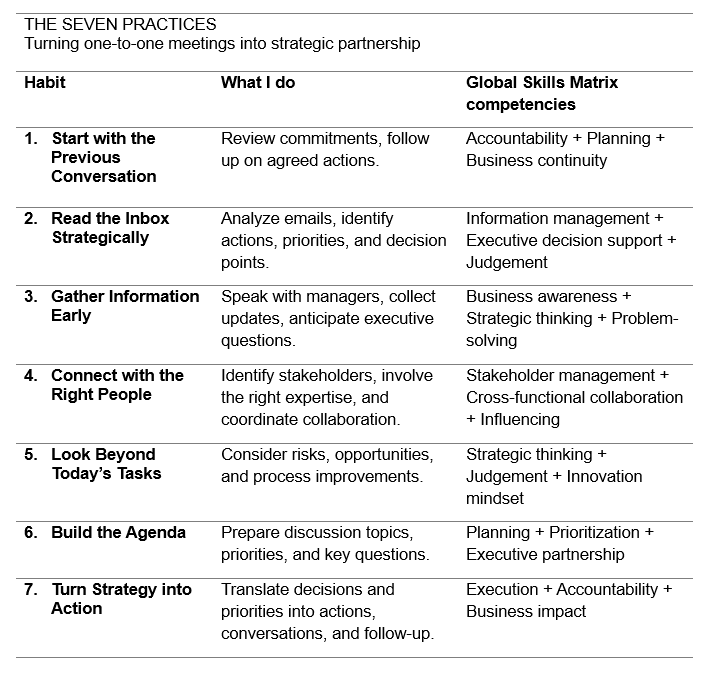
1. Start with the Previous Conversation
Every Business Update Conversation begins where the previous one ended. I revisit my notes to review the decisions we made, the commitments I accepted, and the follow-up actions that still require attention. If my CEO asked me to organize a leadership workshop, follow up with managers, or prepare information for a client meeting, I make sure I know exactly where things stand before we meet again. This simple habit allows our conversations to move forward instead of revisiting unfinished topics.
2. Read the Inbox Strategically
My CEO’s inbox is one of the richest sources of business intelligence. As I review incoming emails, I am not simply looking for messages that need answers. I look for actions that need to be taken, invitations that require a response, topics waiting for approval, project updates, and conversations that deserve our attention. AI can help identify action items or summarize long email threads.
Sometimes several emails belong to the same discussion. Understanding the full context allows me to identify priorities before they become urgent. I do not always have the answer immediately. Discussing these topics with my CEO helps me understand the context behind the emails, align with the reasoning behind the decisions, and prepare responses that reflect our priorities.
3. Gather Information Early
I try to anticipate the questions before they are asked. If we are organizing a client event, I might contact the managers to initiate the process of identifying the clients to be invited, develop the event checklist, and plan out all the necessary steps to ensure the success of the event. If we are waiting for a decision from another department, I often reach out before the meeting to understand the current status. I want to arrive at the meeting with answers rather than assumptions.
One technique I use during this information-gathering phase is to ask myself five questions that I believe my CEO is likely to ask about each of the main topics on our agenda. For example, if I am presenting potential venues for a client event, I ask myself:
- Why are you recommending these venues?
- What are the advantages and disadvantages of each option?
- Which venue best supports the objectives of the event?
- What are the costs, and are they within budget?
- What is your recommendation, and why?
I do not always have the answer immediately. These conversations help me align with my CEO’s thinking, understand the rationale behind outcomes, and prepare responses that reflect our priorities.
4. Connect with the Right People
Business results are achieved through collaboration. As I prepare the agenda for my Business Update Conversation, I think about the people I will need to work with during the week ahead.
- Which managers should I speak to?
- Who can provide information quickly?
- Which stakeholders should be involved before a decision is made?
- Who can help remove an obstacle or accelerate progress?
Thinking proactively about relationships allows me to plan my week more effectively and move projects forward faster. It also helps me identify opportunities to involve colleagues with the right expertise instead of trying to do everything myself.
Bringing this information to the meeting shows my CEO that I am already thinking about execution. I am identifying not only what needs to be done, but also who should be involved to achieve the best outcome. By coordinating the right people and resources, I create more time to focus on strategic work, problem-solving, and enabling effective execution.
For me, this is an important shift in the role of the Executive Assistant.
I am not only a doer; I am also a strategic thinker, a connector, and a facilitator who helps turn priorities into action.
5. Look Beyond Today’s Tasks
One of the most valuable parts of my preparation is taking a step back. Rather than focusing only on my to-do list, I think about the bigger picture.
- Are there risks we should discuss?
- Is there an opportunity we should explore?
- Is there a process that could be improved?
- Are there conversations that should happen before a small issue becomes a larger problem?
This is where I move from coordinating work to contributing strategically.
6. Build the Agenda
Throughout the week, I add discussion points to a shared agenda. By the time we meet, it includes strategic topics, project updates, items requiring decisions, follow-ups, invitations, upcoming travel, budget discussions, and questions that require my CEO’s input.
Whenever possible, I share the agenda at least two days before the meeting. This gives my CEO time to review the topics, add discussion points, prepare questions, and reflect on key issues. As a result, we both arrive well prepared and can focus our time on agreeing on priorities and next steps rather than exchanging information.
As I prepare the agenda, I identify where I need direction, approval, or alignment. I leave the meeting with clarity rather than a longer task list. Good preparation leads to faster execution, greater alignment, and better outcomes.
One CEO I supported once told me she valued our Business Update Conversation as much as I did. Her comment stayed with me because it confirmed that the meeting created value for both of us. Over the years, the executives I have supported have rarely cancelled these weekly conversations.
7. Turn Strategy into Action
During the conversation, we are not only discussing today’s priorities. We are planning the days ahead. Once priorities have been agreed, I know which conversations I need to have, which projects require immediate attention, and where I should invest my time to create the greatest value for the organization. The meeting gives direction to my entire week.
Before the meeting ends, I make sure every decision has a clear next step.
- Who is responsible?
- What is the deadline?
- Which stakeholders need to be informed?
- What should I follow up on before our next conversation?
Capturing these commitments immediately prevents misunderstandings and creates continuity from one week to the next.
When I leave the room, the real work begins. The Business Update Conversation becomes my roadmap for the week. It guides the conversations I will have, the people I will engage, the priorities I will manage, and the actions I will help bring to life.
For me, this meeting is not about reporting on what I have done. It is about ensuring that every action I take contributes to the organization’s priorities.
Final Thoughts
For me, the Business Update Conversation is a practical way of putting the principles of the Global Skills Matrix into action. Every week, it challenges me to strengthen my judgement, collaboration, strategic alignment, and purposeful execution. It reminds me that our greatest contribution is not measured by how much we do, but by how effectively we help our leaders and organizations make better decisions and achieve meaningful results.