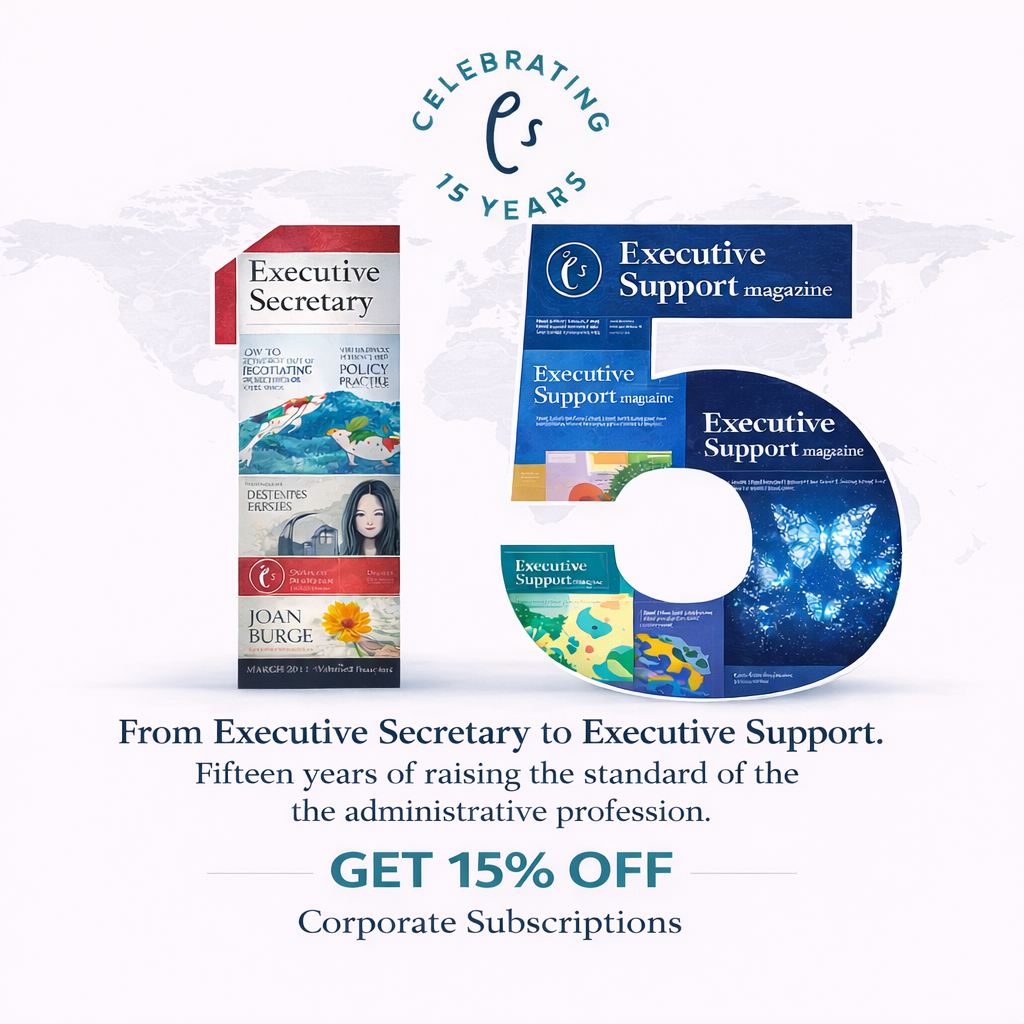


In our 15th Anniversary issue, Lucy Brazier reflects on the changes that have taken place in the administrative profession and sets the stage for the next chapter of evolution
When Executive Support Magazine launched in 2011, the administrative profession was already changing. The work Assistants were doing had evolved faster than the language used to describe it and faster than the structures that supported it.
Much of what Assistants were contributing at that time went unrecognised. Operational judgement, influence without authority, organisational awareness. These capabilities existed, but they were rarely acknowledged.
Over the last 15 years, that has changed, because the profession began to articulate its value, challenge outdated assumptions, and define itself on its own terms. Along the way, Executive Support Mediabecame the hub where those conversations could happen openly, thoughtfully, and with seriousness.
Here are 15 of the most significant shifts the profession has seen since 2011:
1. The Role Stopped Being Defined by Tasks
In 2011, most Assistant job descriptions still read as lists. Calendars, travel, expenses, meetings. Necessary work, certainly, but an incomplete picture of the role as it was already being done.
What those descriptions failed to capture was judgement.
Today, Assistants are increasingly valued for how they prioritise, shape, and direct work, rather than for what they personally execute. LinkedIn research now shows that Assistants spend around 30% more time on strategic activity than they did just three years ago. This is not a sudden change in capability, but a shift in the role that is finally becoming visible.
Technology, including artificial intelligence, has accelerated this process. As execution becomes easier to automate, the aspects of the role that cannot be replicated have come into sharper focus: context, risk, timing, organisational awareness. AI did not redefine the role. It clarified it.
2. Assistants Found the Language to Describe Their Value
For years, Assistants knew they were contributing more than their job titles suggested but lacked the vocabulary to explain how.
Over time, the profession developed a shared language – one that could describe influence, operational leverage, decision support, and strategic partnership. That language changed conversations with leaders, HR teams, and organisations.
3. Career Progression Became Visible
In 2011, many Assistants were told there was nowhere to go. You were either an Assistant, or you left the profession entirely.
Today, career pathways are part of the conversation. Senior roles, leadership positions, portfolio careers, and specialist tracks are increasingly recognised. The idea that administration is a career with depth, progression, and longevity is no longer controversial.
4. The Global Community Took Shape
Assistants have always learned from one another, but 15 years ago that learning was largely local.
The profession is now visibly global. Shared challenges, shared standards, and shared ambition connect Assistants across countries and cultures. This sense of collective identity has strengthened confidence and raised expectations.
5. Professional Development Became Strategic
Training once focused primarily on tools and systems.
Today, development is increasingly about capability: business acumen, influence, communication, emotional intelligence, and systems thinking. Assistants are investing in themselves as professionals, not simply as support functions.
6. The Narrative Shifted from Support to Partnership
“Support” was once the dominant narrative. Useful, but limiting.
Over time, Assistants have reframed their role as partnership. Not equal in title, but equal in responsibility for the administrative part of the outcomes. This shift changed how Assistants show up, and how the strongest leaders engage with them.
7. Senior Assistants Became Visible Leaders
In 2011, Senior Assistants existed, but they were rarely visible beyond their organisations.
Today, administrative leaders, Chiefs of Staff, and Heads of Executive Support are shaping strategy, managing teams, and influencing enterprise-level decisions. Visibility has changed aspiration, and aspiration has changed behaviour.
8. Evidence Entered the Conversation
For many years, Assistants relied on anecdotes to justify their value.
Research changed that. Surveys, benchmarks, skills frameworks, and data provided credibility in rooms that respond to evidence. Once impact could be demonstrated, not just described, the conversation shifted.
9. Confidence Was Recognised as a Capability
Confidence was once treated as personality. Something you either had or did not.
It is now understood as a capability that can be built through clarity, preparation, self-knowledge, and experience. Assistants increasingly recognise that confidence is not about volume, but about grounding.
10. Assistants Became Central to Change
Transformation initiatives once happened around Assistants.
Now, they often happen through them in the form of digital transformation, organisational redesign, and cultural change. Assistants are frequently the only people with the visibility to understand how decisions will land in practice.
11. Boundaries Became Part of Professionalism
Long hours and constant availability were once worn as a badge of honour.
There is now a growing recognition that sustainable performance requires boundaries. Assistants are redesigning ways of working, protecting capacity, and modelling healthier expectations, for themselves and for their leaders.
12. Titles Began to Reflect Reality
Titles still lag behind responsibility in many organisations, but the conversation has changed.
Titles are no longer seen as cosmetic. They are understood as signals of scope, accountability, and value. When titles do not reflect reality, risk follows.
13. Strategic Access Was Reclaimed
Boardrooms and leadership meetings were once considered out of bounds.
That has changed. Assistants have made a compelling case for why proximity to decision-making improves execution. Being in the room is increasingly understood as operational necessity, not entitlement.
14. Poor Leadership Was Challenged
Perhaps one of the most significant shifts has been cultural.
Assistants are no longer expected to absorb dysfunction silently. There is a growing willingness to challenge poor behaviour, unsafe cultures, and outdated attitudes, professionally and with clarity.
15. The Profession Began to Shape Its Own Future
In 2011, Assistants largely reacted to change.
In 2026, they design it. Skills frameworks, career pathways, technology adoption, role redesign – the profession is increasingly proactive, not passive.
Looking Ahead
If the last 15 years were about legitimacy, the next 15 will be about influence. Not influence for its own sake, but influence in terms of facilitating better decisions and more sustainable leadership.
As the profession matures, administrative work is increasingly understood not as support operating from the sidelines, but as part of the operational infrastructure of the organisation itself. The focus is shifting away from outputs (what is produced, completed, or delivered) and towards outcomes (what moves the organisation forward, reduces risk, and enables effective leadership).
The administrative profession will not be defined by technology, artificial intelligence, or changing workplaces. It will be defined by how Assistants apply judgement, insight, and human understanding to shape those outcomes, particularly in environments that need clarity and cohesion more than ever.
Executive Support Magazine was created to treat the administrative profession with the seriousness it had long deserved, offering language, evidence, and a platform for work that was already far more substantial than it was seen to be.
The profession did not arrive here by accident. It arrived here through clarity, courage, and collective voice.
The next chapter will demand even more of all three.