

Administrative operations are evolving quickly; now is the time to define our profession with clarity and purpose, explains Molly Denham
The business environment is evolving at a pace that continually tests our adaptability. Technology advances daily; organizational models shift, and expectations continue to rise. For administrative professionals, the question isn’t whether our field will change but whether we are prepared to take ownership of that change and shape it ourselves.
In 2024, I wrote about the need to redefine our professional identity, beginning with something as simple yet powerful as embracing the title of “administrative professional.” That linguistic shift sparked a larger conversation about our value and the importance of positioning ourselves not on the periphery, but at the center of organizational success. Since then, our community has validated one another’s experiences, raised important questions, and shared countless ideas.
The time has now come to put some action verbs into our sentences. We must take the next step and do the hard work of building a profession that is clearly defined, widely understood, and structurally recognized. Progress depends on three interdependent pillars: professional identity, career progression through structured learning, and advocacy. Together, these form the foundation for meaningful change – change that demands coordination, commitment, and the courage to not just claim our rightful place in the professional landscape, but to create it.
Pillar One: Professional Identity
Every profession begins with clarity of purpose. For administrative operations, that clarity rests on a defined set of core functions: information stewardship, systems management, strategic communication, program and project coordination, and organizational continuity. These are not abstract categories; they are the operational lifelines that keep organizations running efficiently.
Carrying out these functions requires a defined set of essential core competencies. These are the non-negotiable foundational skills every administrative professional must possess: cybersecurity, information systems technology, records management, operational communication, project and process management, and office management and leadership. These form the bedrock of our profession. Each can be deepened as careers advance, but together they establish a shared skillset that transcends individual roles and industries.
When we define and claim these functions and core competencies as ours, we stop being a collection of disconnected job titles and become a unified profession with a shared language and a defined body of work. That identity makes us recognizable, credible, and defensible. It gives organizations a clear understanding of what administrative professionals contribute and why those contributions are indispensable.
This is the first step toward professionalization. Without it, our field remains fragmented and misunderstood. With it, administrative operations can finally be recognized as a critical component of organizational strategy and success.
Pillar Two: Career Progression and Structured Education
Defining our professional scope of functions and competencies is only the beginning. For credibility to take root, we must build a system of career-long education and structured progression. Professional growth cannot be left to chance or limited to ad hoc training. It must be embedded into the profession itself.
A staged framework of education and certification provides professionals with a clear way to assess current capabilities and plan next steps. For organizations, it ensures confidence in hiring, roles are matched to skills, job descriptions become more accurate, and positions reflect defined functions rather than “catch-all” lists that dilute value.
A structured pathway gives shape to the career journey. Entry-level professionals master foundational skills. Mid-career practitioners expand into leadership and project management. Advanced professionals move into strategic coordination, policy shaping, and cross-functional guidance. At every stage, progression is purposeful and supported by level-appropriate education.
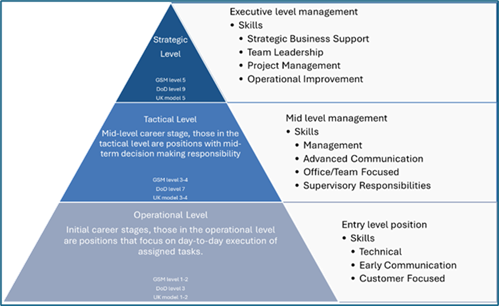
This is more than professional development. It is a strategic investment in a purposefully built career. For administrative professionals, it ensures skills evolve and grow along a career pathway. For employers, it delivers a capable, future-ready workforce. With education and certification aligned directly with defined functions and core competencies, the profession gains both structure and scalability.
Pillar Three: Advocacy
If identity defines who we are, and education defines what we can do, then advocacy determines how far we go. Administrative professionals have always been natural networkers, eager to share knowledge and support one another. That sense of connection is one of our greatest strengths.
But the next stage requires us to channel that energy outward. To elevate the profession, we must engage with the external entities that define how we are classified and valued in the workforce. This includes collaborating with government labor agencies to ensure our field is accurately classified and represented. It also includes educating HR and recruiting organizations to align job postings with our core competencies. Finally, it includes urging business leaders to recognize administrative operations as a core business function – one that merits representation in the C-suite – not a catch-all for disparate tasks.
Advocacy means speaking in a unified voice and challenging outdated assumptions. It means amplifying our credibility by demonstrating measurable outcomes and insisting on our rightful place in organizational structures. It means raising the visibility of administrative operations across industries, not just within the vacuum of our own professional administrative circles.
From Vision to Action
These three pillars provide a framework, but they remain abstract until we act. This responsibility lies with both individuals and professional associations. The work ahead is complex, but it is achievable with focus, persistence, and collaboration.
We must begin by creating working groups to standardize the terminology of our field. Shared vocabulary is the foundation of shared credibility. From there, we can map out a career framework acknowledging individual differences but affirming the common foundation we all share. The framework must then be linked to an educational pathway aligned with defined career progression, ensuring each level is supported by purposeful learning opportunities.
At the same time, we must engage external agencies that classify our field and update the language they use. We must partner with HR and recruiting bodies to reflect our true scope and potential contributions. And, perhaps most challengingly, we must help businesses restructure their organizations so administrative operations are recognized as a strategic function, represented in the C-suite, and integrated into decision-making.
This will not be easy. It will require persistence, coordination, and leadership from within. But if we are serious about reimagining our profession, these are the steps we must take. It is time for administrative professionals to move from conversation to transformation.
The business world is not waiting for us; change is already underway. The question is whether we will define our profession on our own terms or continue to let others define it for us.