
Balancing executive support with community building, Carrie Huong Tran brings purpose-driven leadership to her work, championing both organisational success and the evolving role of administrative professionals in Viet Nam
What does a typical day look like for you?
To me, it’s like tending a garden. My work is like that of a gardener making a daily round; it is constant quiet cultivation. I take away the operational weeds to keep our regional strategies moving forward and I check the soil to ensure my team has the support they need. My goal is simple: to create just the right conditions for the leaders around me to thrive while patiently planting the seeds that will help our Viet Nam administrative community flourish.
I start my mornings early here in Da Nang, a beautiful coastal city in central Viet Nam. Before the rush of the day begins, I often try to take a quiet moment to enjoy the coastal breeze and dedicate 15 to 20 minutes to Pilates. It’s a small ritual that counters the physical toll of a “desk job” and centers my mind before I focus on getting my seven-year-old, Momo, ready for school.
My manager is based in Switzerland, and the time zone difference is a strategic advantage. It gives me several uninterrupted hours to arrange the day before his digital world wakes up. As the Executive Assistant for the East Central Asia Pacific region, I use this quiet time to triage complex inquiries in his inbox, optimize his complex and multiple-time-zone schedule, and manage the logistical aspects for our international forums. Since he is a frequent traveller, my top priority is to ensure every itinerary, briefing document, and report is effectively aligned before he even logs on.
Midday my time – morning in Switzerland – we have a crisp 15-to-30-minute sync to align on the day’s priorities, project updates, and key actions. From there, I move into more operational agility. I recently joined a “champion” force on our AI Pilot program. Now I spend my time embedding Copilot and automated workflows across our team to remove bottlenecks. My most fulfilling hours are the two I carve out weekly for professional development. I am currently working on expanding my professional skill set by learning facilitation techniques and change management.
As both the corporate day and the family evening time wind down, I turn my attention to my passion projects – a shift from a corporate executive partner to a community builder, mentor, and translator for Enlightenia and Enlighten Books. Whether reviewing translation drafts, designing workshops, or listening to my mentees, I view these evening hours not as “work”, but as a privilege. Dedicating this time to partly contributing to the elevation of the administrative profession in Viet Nam is the very thing that sustains my energy and constantly reminds me why I love what I do.
It might sound like a long day, but the dual impact of driving regional conservation operations and empowering my local community keeps me deeply energized. Ultimately, whether I am raising my Momo, partnering with a global executive, or building a professional network, my mission is the same: I am simply creating environments where the people around me have the clarity and support they need to thrive.
What do you see that your executive doesn’t?
Leaders are inherently horizon-eyed. They need to be thinking of the big picture, future and external partnerships. But as a strategic partner, my eyes are on the ground. I look at the roots like a farmer working the earth. What I see is often unspoken, such as the daily friction, the hidden roadblocks, the true emotional pulse of the team. I see what that big vision really feels like to the people doing the work, the fatigue that is starting to take hold, and who is quietly holding all the pieces together behind the scenes.
I remember our regional leadership retreat in Da Nang last December, where I hosted about 30 leaders from our region. My executive focused on the big conservation goals and the main message for leaders from our Asia Pacific region. Meanwhile, I paid attention to the team’s wellbeing. The agenda was packed with discussions and presentation sessions, and I knew everyone would be exhausted. You can’t expect people to stay awake and energized if all they do is talk strategy for hours on end. So, I quietly adjusted the schedule. I added real breaks and relaxed local moments, like the Viet Nam chocolate-tasting challenge and the Vietnamese coffee workshop, so people could connect on a personal level. Caring for the team instead of just the numbers changed the whole atmosphere. We didn’t just get through a tough week of meetings; we built real trust, boosted morale, and set the stage for our big goals to succeed.
How do you protect or nurture your own wellbeing?
I’ve learned to protect my peace and be careful about what I allow into my life, both online and offline. Living by the ocean helps me stay grounded when work gets stressful, and I always make time to step away from my screens and turn off notifications once I’m done for the day. What really keeps me energized, though, is my community work. Many people think running Enlightenia drains me, but it restores my energy. For me, true wellbeing comes from doing work that matters to my heart. Watching my fellow Vietnamese Assistants grow, find their confidence, and change their careers gives me a strong sense of purpose, even on the toughest days.
What is the career moment you’re most proud of?
Earning my MBA on a scholarship while working full-time was a big achievement, but what matters most to me isn’t the awards. It’s about the community we’re creating. Launching Enlighten Books and seeing Vietnamese versions of The Modern-day Assistant and The Leader Assistant reach local professionals has been the highlight of my career.
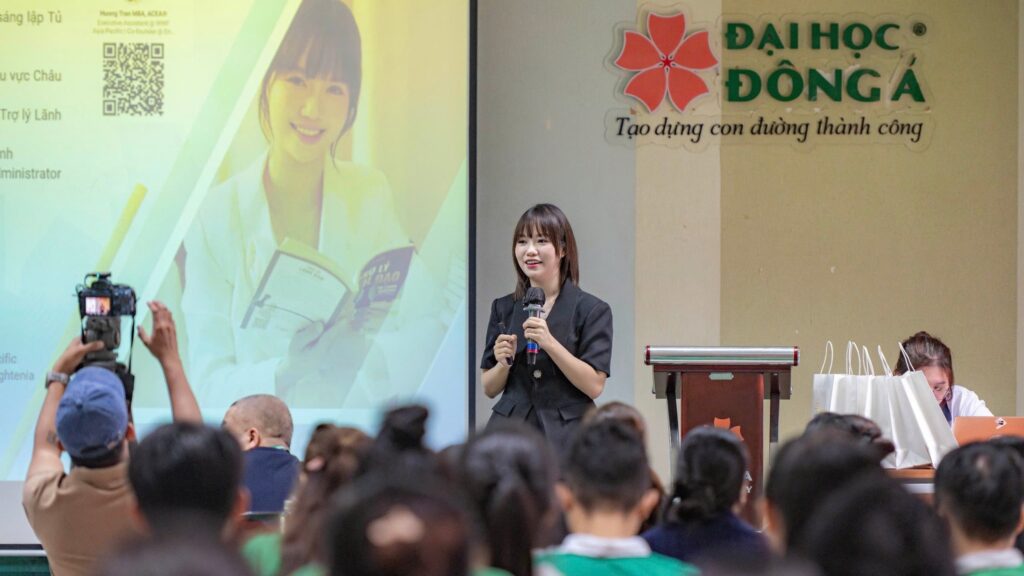
For years, people in Viet Nam didn’t recognize the real leadership potential in our field. We wanted to change that, so we organized a book launch and a symposium with VnEconomy, the most well-known economy magazine in Viet Nam. The room was full, and we even appeared on national TV. Watching hundreds of professionals see the value in their careers was amazing. But the moment that stayed with me happened after the event, when a mother hugged me and introduced her daughter, an undergraduate, who wanted to become an Executive Assistant. They had travelled over 200 kilometers just to attend.
It became more than just a book launch. We were shifting the story from being seen as “just support staff” to being recognized as strategic partners. Helping build this community and empower our profession in Viet Nam is the greatest reward I could hope for.
What mistake have you learnt from?
When I first began sharing international resources and books with the Vietnamese administrative community, I assumed that global standards would be a perfect fit for our local culture. I believed that simply offering high-quality translated materials from world-class, reliable sources would make an immediate difference. However, I soon realized that administrative professionals in Viet Nam deal with very different cultural hierarchies and workplace dynamics, capability, and mindset development than those in the USA, the UK, or Australia, where these standards have been in place for years.
For example, Western resources often advise Assistants to protect their boundaries by practicing saying “no” to their executives. In Western culture, “no” can stand alone as a complete answer. However, in Viet Nam’s high-context, hierarchical culture, an Assistant giving a direct “no” to a senior director may come across as disrespectful. We needed to address this with a different approach that some of my Western colleagues call “passive-aggressive”. We discussed how to say “no” in a more graceful way, such as by offering alternative solutions or negotiating timelines, so Assistants could protect their focus while still showing respect for our cultural norms.
I noticed another major difference when it came to personal tasks. Many global sources say that strategic partners should not handle an executive’s personal errands. But in many Vietnamese corporations, especially family-owned businesses, which still make up the majority in Viet Nam, being trusted with personal matters is a strong sign of loyalty and being a part of the executive’s inner circle. Rather than telling Assistants to refuse these tasks, we talked about how to leverage that trust to earn a place at the strategic table so that the executives can reallocate their time to more strategic initiatives and give them the ownership to delegate those tasks to other reliable people.
It became clearer to me that just providing books or reading materials was not enough. We needed to adapt these resources to fit our own cultural, economic, and corporate context. This realization inspired me to focus on building a strong community, where we can connect personally and share our unique stories. To truly advance the administrative profession in Viet Nam, we needed more than just tools. We had to create a safe, local space to talk about how to use global ideas in our daily work and to learn from each other’s experiences so we can grow together.
If I wasn’t an EA, I’d be …
If I had chosen a different path, I would be a learning designer or a university lecturer. My MBA professor first suggested I consider academia and really encouraged me to pursue it. Back then, I was eager to put business theory into practice and honestly felt a bit worn out from all the research. Lately, though, I’ve had the chance to guest lecture at universities, and it just felt right. When I spoke with undergraduate students, I immediately felt a strong connection to their potential. I realized that meeting them at the start of their careers would let me help shape how they see the administrative profession before they even enter the workplace. If I weren’t an EA, I’d dedicate myself to supporting the next generation of professionals, helping our community grow, and making sure they feel ready to lead from day one.